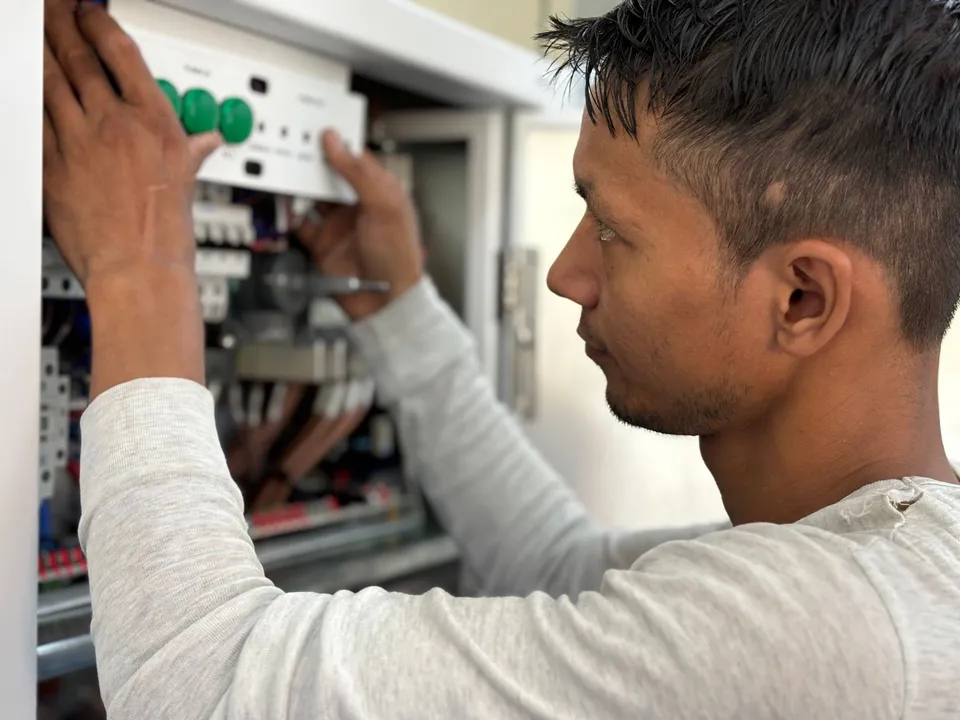
Why apprenticeship fits the work better than a one-time hire
Data center employers often say they want experience, but the work itself rewards something more durable: disciplined repetition, clean handoffs, and judgment that can be trusted on a live site. That is why registered apprenticeship is such a strong fit for the sector. In the data-processing, hosting, and related-services subsector, BLS reports average hourly earnings of $59.68 for all employees and average weekly hours of 38.2 in May 2026, with production and nonsupervisory employees averaging 37.5 hours. In other words, this is steady, full-time infrastructure work, not casual labor. At the same time, registered apprenticeship is built around paid work experience, a mentor, classroom instruction, and progressive wage increases. Those two facts point to the same hiring conclusion: data center employers do better when training is treated as a visible path, not an invisible expectation.
The real product is judgment
A résumé can show that someone has turned wrenches or closed tickets. It is much harder to show that the person will document a condition clearly, escalate at the right moment, and stop work when the boundaries change. That is where the occupational evidence matters. O*NET task lists for relevant occupations repeatedly include documenting activities, recording repairs, training others, assigning duties or schedules, maintaining contingency plans, and conferring with coworkers. Those are not side chores; they are the daily habits that keep a data center reliable across shifts, vendors, and maintenance windows.
For employers, that means the best apprenticeship is not just a way to teach tools. It is a way to teach the work system around the tools: how to write down what changed, how to hand off cleanly, how to preserve evidence, and how to know who has authority to touch which system. A technician who learns those habits early is easier to supervise and more likely to become a reliable shift partner later.
Not every data center job belongs in the same pipeline
One reason apprenticeship works is that it forces employers to name the occupation instead of hiding behind a broad title like “technician.” That distinction matters because data center work is split across several job families. HVAC mechanics work on cooling systems. Industrial machinery mechanics maintain plant equipment. Electrical and electronic engineering technologists and technicians work on controls and circuitry under engineering direction. By contrast, computer network architects and information security analysts work on logical networks and security, not on chillers, switchgear, or airflow. Same building, different work.
That separation should shape hiring. A candidate with strong commercial HVAC experience may be a good fit for a plant-room apprenticeship, but that does not automatically make the person ready for controls troubleshooting, energized electrical work, or network-side responsibilities. The reverse is also true: someone with server-room or cabling experience may understand the information side of the site without being prepared for the physical plant. Apprenticeship works best when the employer chooses one lane and builds from there.
Build, commissioning, and operations need different learning plans
The sector also changes by project stage, and that is one reason generic hiring plans fail. Construction electricians on a fit-out are working inside a project safety plan. OSHA’s data-center-project agreement for Holder Construction described daily and weekly safety toolbox talks, third-party crane inspection, critical-lift planning, and injury and illness tracking. That is a construction workforce story, not an operations story.
Commissioning sits between the two. It is the stage where systems are tested, evidence is collected, and the site moves toward turnover. The work demands documentation discipline and close coordination because the team is proving that equipment performs as expected before the operator assumes day-to-day responsibility. O*NET’s task language around contingency plans, testing, repair records, and coordination fits that bridge stage well.
Operations is different again. Once the site is live, OSHA’s lockout/tagout rules and electrical-hazard expectations govern how work can be done, and the site depends on documented procedures to prevent unexpected energization or release of stored energy. That makes the operating technician’s world one of controlled access, maintenance records, and supervised practice. Apprenticeship is especially useful here because the worker is expected to learn the site the slow way, under a mentor, until the rules become habit.
The strongest apprenticeship models already look like data center work
The best published programs already show what employers should be teaching. Mesa Community College’s Data Center Operations certificate includes Industrial Safety, Modern Maintenance Operations, Mechanical Power Transmission Systems, Introduction to Data Center Operations, DC and AC Components and Circuits, PLC Programming and Troubleshooting, Industrial Motors and Motor Control, and Power Distribution Systems. That course list is revealing because it mixes safety, mechanics, electrical basics, controls, and operations. It is a curriculum map, not a slogan.
Germanna Community College’s AWS-linked pre-apprenticeship makes the same point in shorter form: four weeks of hands-on instruction in electrical, HVAC, mechanical, and data center operations. Northern Virginia Community College’s apprenticeship work, meanwhile, shows employers and schools building regionally anchored pipelines for industrial maintenance technicians in data center and semiconductor-related work. These programs matter because they show the sector is already using apprenticeship logic: start with the core tasks, then layer in more responsibility.
What employers gain when training is formalized
A registered apprenticeship gives employers three practical advantages.
- Better screening. The employer defines the occupation and the training plan, so the hire is matched to real work instead of a vague technical background.
- Safer onboarding. Workers learn what they can and cannot touch before they are expected to work independently in live areas.
- Clearer retention. Progressive wage increases connect pay to verified skill growth, which gives employees a reason to stay and gives supervisors a way to reward progress without improvising the ladder.
For applicants and early-career workers, the value is just as real. Apprenticeship is not a detour around the trade; it is often the trade’s first serious structure. If a program includes a mentor, a classroom component, and a clear wage path, the worker can see how a first job becomes a longer career. That matters in a sector where the real difference between a good hire and a risky hire is often not raw enthusiasm, but the ability to work within tight boundaries and write the work down correctly.
A practical way to start
If you are hiring for a data center site, the best first step is to write the first 90 days of work before you write the posting. Separate construction, commissioning, and operations. Name the one role family you actually need. Then map each task to the training, mentor, and sign-off it requires. That exercise is small, but it forces the right question: are you looking for a title, or are you building a worker who can be trusted with the site?