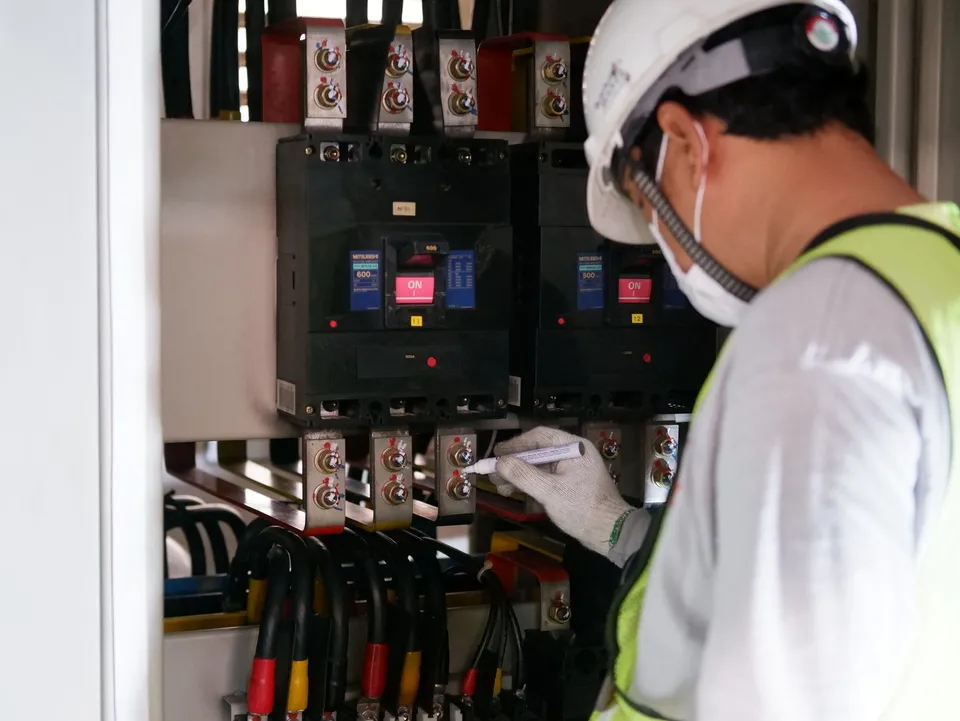
The same data center campus can need two very different workforces before and after it goes live. During construction and fit-out, crews are installing systems, pulling cable, setting equipment, and proving that the building can work as designed. After turnover, the operating employer is maintaining energized equipment, documenting changes, and controlling who can touch what. That split matters because the U.S. data-processing and hosting subsector is already a substantial operating labor market: BLS counted 56,613 private establishments in fourth quarter 2025, and in May 2026 it reported average hourly earnings of $59.68 for all employees and average weekly hours of 38.2. Those numbers describe live operating establishments, not the temporary surge of project labor that appears before a site opens.
Build work is not live-site work
OSHA’s lockout/tagout rule is one of the clearest reasons not to blur the phases. It applies to servicing and maintenance, and OSHA notes that construction employment is outside that specific standard, even while electrical hazards in utilization installations are covered elsewhere. In plain English, the person installing or supporting startup does not automatically work under the same rules as the technician who later maintains the equipment while it is energized. The Holder Construction data-center agreement shows what the build phase looks like in practice: daily and weekly safety toolbox talks, third-party crane inspection, critical-lift planning, and injury/illness tracking. That is a project-control environment, not a steady-state maintenance shop.
Commissioning and turnover reward documentation, not just experience
The middle stage is where hiring mistakes become expensive. The source material treats commissioning and turnover as a handoff problem: test procedures, documentation, training, and clear ownership of what was verified. O*NET task lists reinforce that point. Computer network architects maintain contingency plans, coordinate hardware and software installation, develop testing routines, and document network-related activities. Industrial machinery mechanics record repairs, observe equipment in operation, and analyze test results. The lesson is not that everyone should do everything. It is that the team must be able to prove what was tested, what was accepted, and who owns the next action.
That is also why title matching alone is risky. A résumé that says “technician” can point to several different jobs. In the data center world, HVAC mechanics work on cooling systems; electrical power-line installers and repairers work on distribution systems, transformers, breakers, and switches; electrical and electronic engineering technologists work under engineering direction on circuitry, controls, and machinery; industrial engineers handle logistics, quality control, and production coordination; and network architects and information security analysts stay on the logical side of the building, not the chillers or switchgear. Those are adjacent skills, but they are not interchangeable.
The training pipeline already reflects those boundaries
Published training programs make the same distinction. Mesa Community College’s Data Center Operations certificate is built around industrial safety, maintenance operations, mechanical power transmission, DC and AC components, PLC programming, motors, and power distribution. Germanna Community College’s AWS-linked pre-apprenticeship focuses on electrical, HVAC, mechanical, and data center operations over four weeks. Those are not generic tech courses. They are evidence that the sector values people who can cross power, cooling, controls, and operations boundaries without confusing one for the other.
The apprenticeship model says the same thing in workforce terms. Registered apprenticeship requires a specific occupation, a training plan, a training provider, paid work experience with a mentor, and progressive wage increases. That structure matters because it creates a verified path from entry skill to higher responsibility. It also gives employers a cleaner way to decide whether they need a build-phase helper, a commissioning assistant, or a live-site operator with documented competency.
What employers should screen for
The strongest hiring signal is not “technical background.” It is stage fit. Ask whether the candidate has worked in a build phase, a startup or commissioning phase, or a live operations phase. Ask what they documented, who signed off, and what authority they had when a system was energized. Ask whether they have worked from a punch list, a change record, a maintenance record, or an escalation log. Those are different habits, and they matter because the hazards and decision rights change as a site moves from project to operations.
The pay and hours data also help explain why schedule conversations matter. In the subsector, BLS reported 37.5 average weekly hours for production and nonsupervisory employees in May 2026, which looks like a standard full-time operating environment rather than casual labor. That does not tell us who works nights, weekends, or on-call, but it does show that this is not a loose, ad hoc labor market. For employers, that means the job description should say whether the role is project-driven, shift-based, or maintenance-based instead of assuming applicants will guess. For applicants, it means you should be specific about whether you want a construction rotation, a commissioning assignment, or a stable operations schedule.
What applicants should say
If you are applying, name the stage you know. If you supported fit-out, say so. If you worked on commissioning punch lists, say so. If you have live-site maintenance experience, explain how you handled lockout/tagout, handoffs, and change records. If your background is on the IT side, distinguish network support, systems work, and information security from facility maintenance. That language helps employers separate contractor-side labor, commissioning support, and operations staffing without guessing, and it protects you from being matched to a role that is outside your actual experience.
The practical takeaway
The data-center workforce is not one labor market. It is a sequence of labor markets that overlap at the same site. Build crews, commissioning teams, and operations staff may all work in the same building, but they answer to different rules, different paperwork, and different risk profiles. That is why better hiring starts with a simple question: are we filling a project stage or a stable operating role? When employers answer that first, they write cleaner job descriptions, set better expectations, and keep more people in the right lane. If you want to compare that stage-specific approach with current employer and applicant resources, start with the employer page and the job-seeker page.