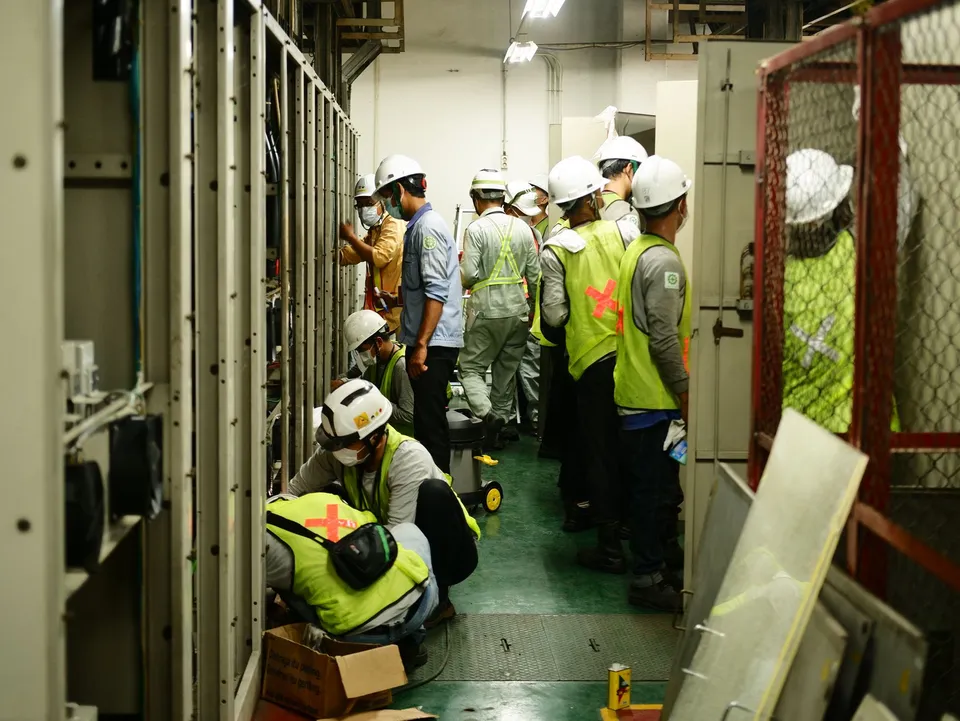
In a data center, the same building can hold three different kinds of work at once: contractor-led build work, commissioning and turnover, and the steady-state operating job. That is why a resume with “technical experience” is not enough. BLS’s data-processing, hosting, and related-services subsector reported 56,613 private establishments in fourth quarter 2025 and average hourly earnings of $59.68 in May 2026; it also counted 24,940 computer support specialists, 14,540 computer systems analysts, and 2,630 computer programmers inside the industry. The workforce is already mixed before you add contractors and specialty vendors.
Build work is contractor-owned
OSHA documentation for Holder Construction’s data-center projects shows the construction phase is governed by daily and weekly safety toolbox talks, third-party crane inspection, critical-lift planning, and injury and illness tracking. Those are not the rhythms of a permanent operations team; they are the rhythms of a live project. That matters because hiring for build work should emphasize sequencing, hazard awareness, and site discipline rather than simply steady-state maintenance habits. A good construction hire may be excellent at moving with the job package, following a plan, and staying inside a changing work zone, even if that person is not yet the right fit for long-term plant operations.
Commissioning rewards documentation, not just experience
Commissioning sits between install and run. The source set does not give one universal commissioning manual, but it does show the ingredients: test procedures, documentation, training, and handoff discipline. O*NET tasks for network architects include documenting activities, maintaining contingency plans, and coordinating hardware and software installation; industrial machinery mechanics record repairs, observe equipment in operation, and analyze test results. In practice, that means a commissioning or turnover candidate must prove that they can leave the next person a usable record, not just fix a problem once. A site that treats turnover as a paperwork nuisance usually pays for that mistake later in repeat work, unclear ownership, and avoidable downtime.
This is also where title matching breaks down. A “technician” on one project may be part of a contractor team closing out punch-list items, while a “technician” in operations may be responsible for preventive maintenance, change records, and escalation. The federal sources reviewed here do not support collapsing those into one job family, and they do not support pretending that the same person should be hired the same way for both phases.
Operations and IT are adjacent, not identical
Once the building is live, the work splits again. The same industry houses support specialists, systems analysts, and programmers, but those IT roles do not replace facilities staff who maintain cooling, power, and plant equipment. O*NET’s occupation descriptions draw hard lines between HVAC mechanics, industrial machinery mechanics, electrical and electronic technologists, network architects, and information security analysts. A candidate with commercial HVAC experience may fit a plant-room role, but that does not make the person ready to work on controls, switchgear, or network architecture. Employers get better results when the job posting names the exact system boundary and the exact authorization boundary.
That boundary matters because work authorization is part of the job, not an afterthought. The sources repeatedly point to documentation, observed operation, and coordinated handoff as everyday work habits. In other words, the question is not only whether someone can do the technical task. It is whether they know when they are allowed to touch the system, when they must escalate, and what record needs to follow the work. That is a workforce issue as much as a technical one.
Knowledge transfer is a staffing control
The best data center teams do not depend on memory alone. O*NET task lists repeatedly include documenting activities, training others, assigning duties or work schedules, conferring with coworkers, and maintaining contingency plans. Apprenticeship.gov describes registered apprenticeship as paid work experience with a mentor, progressive wage increases, and classroom instruction. Taken together, those sources make a clear point: knowledge transfer is not soft culture, it is a staffing control. If one person knows the maintenance sequence or one engineer knows the change history for a site, that knowledge has to be written down and taught, or the operation becomes dependent on individual memory.
That is also why the sector’s entry routes matter. Mesa Community College’s Data Center Operations certificate requires 22 credits and covers industrial safety, maintenance, PLC programming, industrial motors, and power distribution. Germanna Community College’s AWS-linked pre-apprenticeship is a four-week hands-on program focused on electrical, HVAC, mechanical, and data-center operations. Those are not generic tech pathways; they are structured pipelines that show applicants what kind of work they can actually support and show employers what kind of role the graduate is ready to enter.
A better screening question for employers
Instead of asking only, “Does this candidate have technical experience?” ask:
- Which phase owns this role: build, commissioning, or operations?
- What systems can the worker touch without supervision?
- What has to be documented before handoff?
- Is the work mainly local, contractor-based, or tied to a mentoring pipeline?
That approach helps employers separate a project electrician from a controls-minded technician, a plant operator from a network specialist, and a turnover lead from a steady-state maintenance hire. It also helps applicants tell a clearer story. A person who has done construction work, for example, should explain whether the experience was on a build crew, a commissioning team, or a service vendor rotation. A person coming from the IT side should explain whether the experience was support, systems analysis, network design, or security work.
Why this matters for staffing plans
Staffing plans work better when they separate build labor, turnover labor, and steady-state labor, then name the skills and documentation each phase requires. The federal sources do not support a universal staffing ratio, and they do not show one schedule pattern for every site. BLS’s industry averages — $59.68 per hour and 38.2 average weekly hours in May 2026 — show the sector is built around full-time technical work, but they do not tell you how a specific site should staff nights, weekends, or on-call coverage. Those decisions belong at the site level, where project stage, system authority, and vendor interfaces actually live.
The practical takeaway is simple: the first question in data center hiring is not the title. It is who owns the work today. Once employers answer that, they can write better job descriptions, set better training expectations, and make better choices about who should enter the site, who should be mentored, and who should be left to operate independently.
If you are hiring, start by mapping the phase and authority boundary before you finalize the posting. Employers can review the employer page; job seekers can compare their experience against the job seeker page.